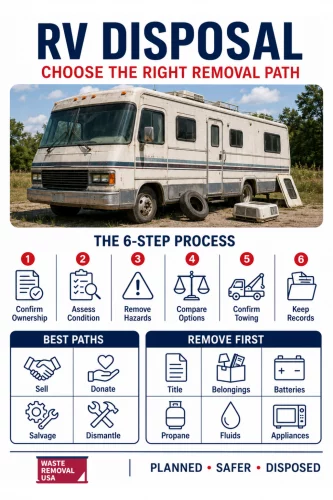
- Confirm ownership and locate the title or other required paperwork.
- Assess whether the RV is roadworthy, towable, repairable, or only useful for parts.
- Remove personal belongings and identify hazardous or restricted materials.
- Compare sale, donation, salvage, removal, and dismantling options.
- Confirm towing requirements and facility acceptance before moving the RV.
- Keep records showing where the vehicle and restricted materials went.
Start by Deciding Whether the RV Still Has Value
 Before arranging junk RV removal, take an honest look at the vehicle.
An RV may still be worth selling if it has a usable frame, intact appliances, working systems, a solid roof, desirable parts, or a title that allows a buyer to register it. Even a non-running motorhome may interest a mechanic, rebuilder, or parts buyer.
Check:
- The roof, walls, and floor for major water damage
- The frame and hitch for structural problems
- The engine and drivetrain on a motorhome
- Tires, axles, brakes, and suspension
- Electrical and plumbing systems
- Air conditioners, refrigerators, generators, and other appliances
- Windows, doors, awnings, furniture, and cabinetry
- Signs of mold, pests, fire damage, or severe contamination
- Whether the title and ownership documents are available
The Best RV Disposal Options
The right method depends on condition, time, access, transportation, and local rules.1. Sell the RV as a Complete Vehicle
Selling is usually the first option to consider when the RV is still usable, repairable, or attractive to someone looking for a project. You may be able to sell:- A roadworthy RV to another owner
- A damaged camper to a rebuilder
- A non-running motorhome to a mechanic
- A vintage trailer to a restoration buyer
- A project RV to someone who wants the frame, shell, or interior
2. Donate an RV That a Charity Will Accept
Some charities accept motor vehicles, including certain RVs, but acceptance standards vary. A charity may require a clear title, accessible pickup location, minimum condition, or enough resale value to justify towing. Do not assume a donation automatically creates a large tax deduction. The IRS has specific vehicle donation rules, including documentation requirements and limits. Confirm that the organization is qualified and keep the required records. Donation works best when the RV has value but you do not want to spend time advertising, showing, and negotiating with buyers.3. Sell or Transfer It to an RV Salvage Yard
A salvage yard may be interested in an RV that is no longer practical to repair but still contains usable components. Usable value may come from:- Engines and transmissions
- Axles and suspension parts
- Generators
- Appliances
- Windows and doors
- Awnings
- Aluminum siding or framing
- Copper wiring
- Furniture and fixtures
- Wheels and other reusable hardware
4. Dismantle the RV for Parts and Materials
DIY dismantling may make sense when the RV has useful parts, no buyer wants it intact, and you have enough room, time, tools, and local disposal options. This is not a quick project. RVs contain layers of mixed materials, including metal or fiberglass panels, insulation, plywood, wiring, plumbing, foam, glass, appliances, and fasteners. Before demolition:- Disconnect all power sources.
- Remove batteries.
- Address propane cylinders and fixed propane systems.
- Drain or professionally handle fuels, oil, coolant, and other fluids.
- Remove refrigerant-containing equipment appropriately.
- Take out reusable parts before damaging them.
- Set up separate areas for metal, glass, appliances, hazardous materials, and general debris.
How to Dispose of an RV Step by Step
A careful process reduces delays and rejected loads.Step 1: Locate the Title and Confirm Ownership
Requirements differ by state and by the type of RV. A motorhome may be titled as a motor vehicle, while travel trailers and campers can follow different state rules. Start with your state motor vehicle agency. USA.gov provides a directory of state motor vehicle services for title, registration, and related questions. If the title is lost, damaged, still in another person’s name, or connected to an estate, resolve that issue before scheduling removal whenever possible. A legitimate buyer or disposal company may refuse a vehicle when ownership cannot be established.Step 2: Remove Personal Belongings
Old RVs often become storage units. Empty cabinets, exterior compartments, under-bed spaces, refrigerators, closets, and hidden storage areas before anyone tows or dismantles the vehicle. Separate belongings into:- Keep
- Sell
- Donate
- Recycle
- Hazardous or special handling
- Ordinary trash
Step 3: Identify Hazardous and Restricted Materials
 Do not treat the entire RV as ordinary debris.
The EPA explains that household products such as oils, batteries, cleaners, and other hazardous materials may require special care at disposal. Local programs and rules vary, so contact the appropriate waste authority before transporting questionable materials. Review the EPA’s household hazardous waste guidance for general handling principles.
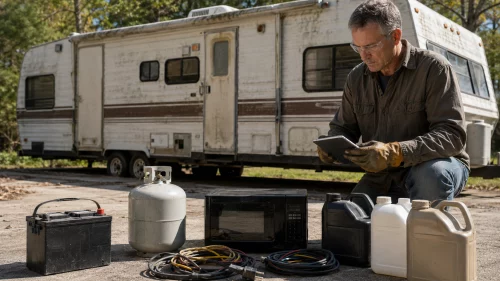
Common items to address include:
- Lead-acid or lithium batteries
- Gasoline or diesel fuel
- Motor oil
- Antifreeze and coolant
- Propane cylinders
- Paints, solvents, and cleaners
- Refrigerants
- Electronics
- Tires
Step 4: Remove Refrigerant-Containing Equipment Properly
RV refrigerators and air-conditioning equipment need special attention. The EPA explains that appliance disposal commonly involves refrigerant recovery and removal of hazardous components before the remaining materials are processed. Check the EPA’s appliance disposal guidance before dismantling refrigerated equipment. Do not cut refrigerant lines or intentionally release refrigerant. If the RV has an old refrigerator, our guide to refrigerator disposal provides more detail on removal options.Step 5: Call Facilities Before You Tow Anything
Never assume a landfill, transfer station, scrap yard, or recycling center will accept a complete RV. Ask:- Do you accept complete RVs?
- Do you accept motorhomes and trailers equally?
- Does the vehicle need a title?
- Must propane tanks, batteries, tires, fluids, or appliances be removed?
- Is an appointment required?
- Are there size, weight, or length limits?
- What are the fees?
- Can the vehicle arrive on a flatbed or tow truck?
How to Get Rid of an Old Camper Trailer
People asking how to get rid of an old camper trailer often have a different problem than motorhome owners. A camper has no engine, but it may still be difficult to move because of failed tires, seized bearings, damaged axles, a rusted frame, or a collapsed body. First decide whether the trailer can be moved safely. If the frame and running gear are sound, a buyer or salvage operator may be willing to tow it. If it cannot roll, removal may require a flatbed, equipment to lift it, or partial dismantling at the property. Do not install tires simply to move a structurally unsafe trailer. The hitch, frame, bearings, brakes, and axles all matter. For a badly deteriorated camper, the most practical sequence is often:- Remove belongings and reusable parts.
- Separate batteries, propane equipment, appliances, and fluids.
- Salvage valuable metal and components.
- Carefully dismantle the remaining shell.
- Sort debris by material and local acceptance rules.
How to Get Rid of an Old Motorhome
Learning how to get rid of an old motorhome involves the same basic options as camper disposal, but the engine and vehicle systems add complexity. A non-running motorhome may still have value because of:- Engine or transmission parts
- Chassis components
- Catalytic converters
- Wheels and axles
- Generator
- Appliances
- Interior fixtures
How to Scrap a Camper Trailer
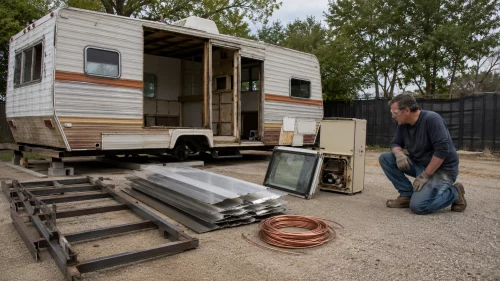 If you want to know how to scrap a camper trailer, the key is separating valuable material from costly mixed debris.
Start with reusable items that can be sold intact. Then separate metals such as steel, aluminum, and copper where practical. Our guide to scrap metal removal explains why sorting can matter when sending material for recycling.
A typical camper teardown may produce:
- Steel frame sections
- Aluminum siding or framing
- Copper wiring
- Appliances
- Glass
- Fiberglass
- Plywood and composite wood
- Insulation
- Plastic tanks and plumbing
- Upholstery and foam
Why RV Removal Costs Vary by Location
RV removal is highly local. Towing distance, access, title requirements, facility rules, disposal fees, and nearby salvage markets can affect the final price. For example, someone arranging RV removal in Jackson, AL, may have different towing and disposal options than a property owner seeking RV removal in Greenville, AL. The same is true for RV removal in Louisville, MS, or RV removal in Asheville, NC. The right process in any of these locations is to confirm:- Ownership paperwork
- Whether the RV can roll or must be lifted
- Access for a tow truck or flatbed
- Distance to the accepting facility
- Items that must be removed first
- Whether local disposal or code rules affect abandoned vehicles